The Good Market That Ran Out
A good market. A careful withdrawal. And the account is gone while you still need it. Here is the force that does it — and the two tools that stop it.
Distribution series · The Order of Things · the Highlights — about an 8-minute read, one of four layers.
— while both of them are still alive
Built from “The Descent” and “The Order of Things,” the full analysis. Every figure below traces to a real cash-flow calculation run on the market’s own published returns.
The Same Market, a Different Number
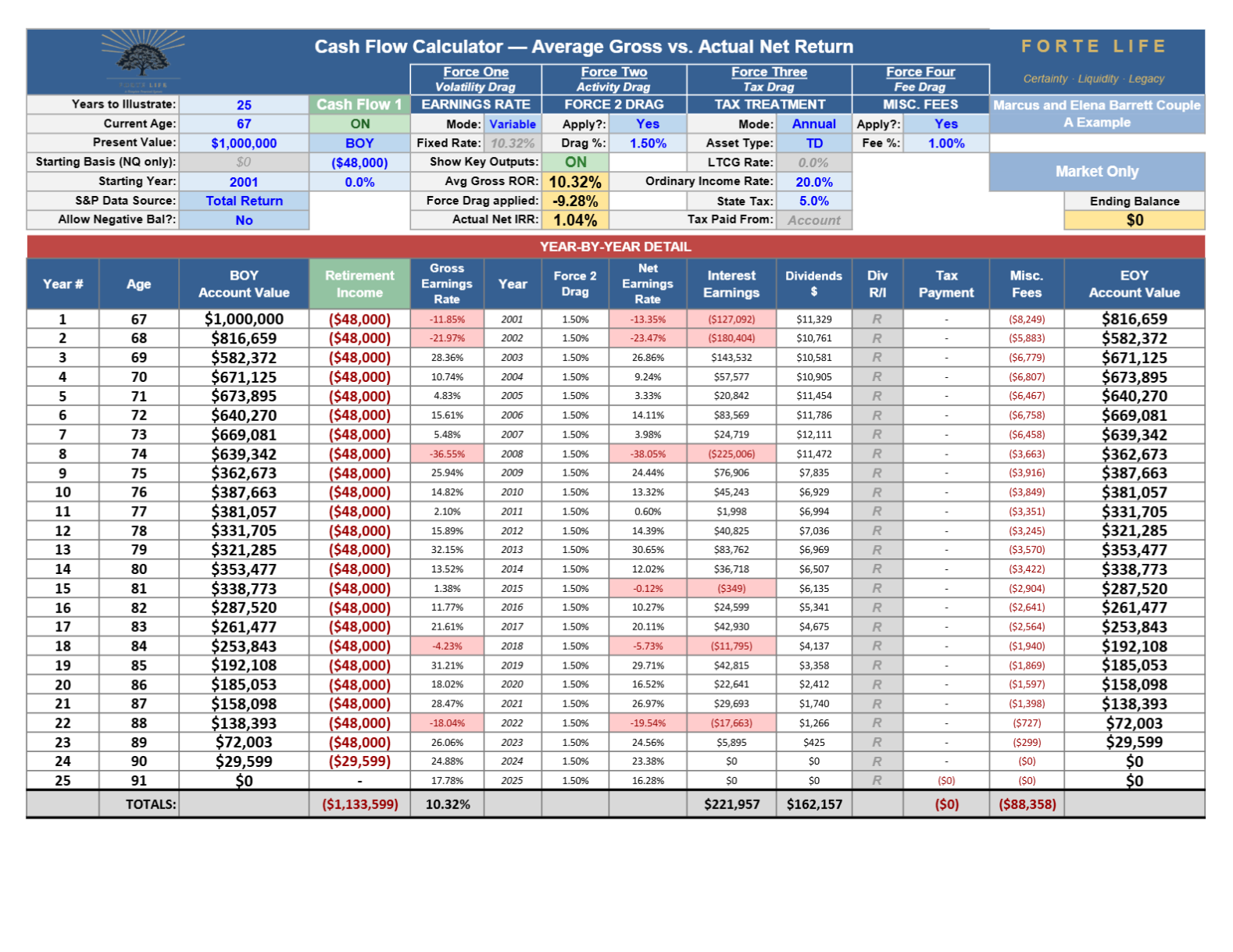
Take the market of 2001 through 2025. It was not a bad stretch — it averaged 10.32% a year, with twenty of its twenty-five years positive. A good quarter-century.
Now put a retired couple into it. They are sixty-seven, they have $1,000,000, and they draw $48,000 a year — a 4.8% withdrawal, squarely inside the range the industry has always called safe. Run their account through the real order those years arrived in, and it pays them for twenty-three years, part of a twenty-fourth, and then it is empty — at age ninety, while both of them are still alive.
Same market. That 10.32% average grew a saver's money right along with it — their dollars simply rode out the dips and recovered. The very same years, drawn on for income, left the retiree with 1.04% and an empty account. Nobody made a mistake. They drew a reasonable income from a reasonable balance in a good market, and it emptied anyway.
How? Not the average. The order.
Why the Order Suddenly Matters
There is a day you spend forty years walking toward — the mortgage gone, the last child launched, the account finally big enough to live on. Everyone calls it the summit. What no one tells you is that the summit is the halfway point, and the second half is the dangerous one.
Every climber knows the accidents happen on the descent — when the legs are tired and gravity is finally at your back. Accumulation is the climb up; retirement is the climb down. Same mountain, but the half where a misstep actually costs you — and it takes different tools than the climb.
Here is the difference in one fact. While you are saving, the order of good and bad years does not matter — shuffle any twenty-five years however you like and you end with the same amount, because your dollars just ride it out. The day you start drawing income, order becomes everything: a dollar you pull out at the bottom is sold and gone, and it isn't there to recover when the market comes back.
It doesn't even take a crash. An ordinary 15% down year needs about a 17.6% gain to recover. But a retiree also withdrew that year — so the account fell closer to 20%, and now needs nearly 24.7% to climb back. An ordinary bad year, turned into a hole a quarter deep, dug at the worst possible moment. Land one of those in the first years of retirement and the account never fully recovers.
It Wasn't Bad Luck
The natural objection is that 2001 was just an unlucky place to start. So we checked every place to start.
The last century holds seventy-six rolling twenty-five-year retirements — every start-year from 1926 through 2001. Run that same household through all of them, nothing skipped, and the market-only plan ran its income dry while the household was still alive in seven of the seventy-six — roughly one retirement in eleven, with no way to know in advance which one you'll be handed.
This is where people ask, so is the market about to be bad? — and that's the wrong question, because no one can answer it. The point isn't to predict the weather. It's to pack for it.
Think of a drive across the country. If raw speed were all that mattered, you'd take a racing motorcycle — nothing's faster. But no one crosses a continent on one, because the trip isn't a sprint: it runs through weather you can't time, it has to carry your family, and above all it has to arrive. A market-only retirement is the motorcycle — quicker on the clear, dry stretches, and sometimes it finishes ahead. The coordinated plan is the car: a little off the top speed, and in exchange a windshield, seatbelts, and room for everyone, built to finish the trip in whatever weather is waiting. No one rides the motorcycle across the country because it's faster.
The goal was never speed. It was arriving.
There's a Second Force, Too
Sequence risk is the danger you can at least picture. There's a quieter one that costs real money: the tax code, which turns from a background cost into an active machine the day you start drawing income.
Underneath it is a bet most savers never knew they made. Every dollar in a 401(k) or IRA was deferred on a promise — pay the tax later, at a lower rate. But that's a wager on a future rate you don't set and can't control, and the ground beneath it isn't reassuring: the federal debt has roughly doubled in a decade, and today's tax rates sit near the lowest they've been in a century, with far more room to rise than to fall.
No one can predict where rates go — which is exactly why you don't bet on it. The coordinated plan spreads your money across the three ways it can be taxed — taxable, tax-deferred, and tax-free — so you're never all-in on the one bucket whose future rate is out of your hands. Done ahead of time, that mix is what keeps more of your retirement income out of reach of the Social Security and Medicare tripwires most retirees never see coming — and it is never too late to start.
Two Tools for the Way Down
A market-only plan asks the market to do the one thing it was never built to do: hand you a reliable paycheck, in an order no one can choose. A coordinated plan doesn't argue with the market — it adds two tools the market-only plan doesn't have.
Take the income you simply must have and move it out of the market's reach, into a guaranteed lifetime income. There's a plainer name for it, one everybody already trusts: a pension. A lifetime annuity is just a pension you build for yourself, now that employers rarely hand one down — and no one ever called their pension a bad deal for “not getting it all back.” Switch it on for that same couple, and the identical $1,000,000 that ran dry at ninety instead pays $48,000 every year for as long as either of them lives and still leaves a legacy larger than they retired with. And it needs no runway — you can put it in place the day you retire.
It is never too late for the floor.
For the extra income above the floor — the travel, the grandchildren — you still want the market, and that's exactly what sequence risk attacks. So you keep a separate, non-correlated reserve, and in the year after a market loss you draw from it instead of your shares, leaving them alone to recover. A reservoir is dug in the wet years; you cannot dig it once the drought has arrived. Tested across all seventy-six windows, this one rule — don't sell into the recovery — improved the market money's outcome in every single one.
The Same Million, Two Endings
| The same $1,000,000 at 67, drawing $48,000/yr | Market-only | With the Firewall |
|---|---|---|
| Income | stops at 90 | for life, both spouses |
| Left to the family at 91 | $0 | $1,169,122 |
| Baseline exposed to the market | all of it | none |
More income and more legacy, from the same starting balance. The market didn't have to earn more — the coordinated plan simply stopped selling at the bottom to fund a paycheck, and never let the order of returns reach the income at all.
Marcus and Elena, both sixty-seven, need $144,000 a year. Between Social Security and a small pension they already have $60,000 of it guaranteed; their savings cover the rest. Here is the part that surprises people: the coordinated version and the do-nothing version save the exact same money — the only difference is where it's pointed. At retirement they build the Firewall to cover their entire baseline by contract, with zero market exposure, and draw only their discretionary income from the market, protected by the Buffer. They gave up nothing in lifestyle. What they got was a paycheck that can't stop and a legacy the market can't erase.
What It Actually Removes
Every retiree carries two, whether or not they say them out loud: living longer than the money lasts, and going too soon and leaving less than they meant to. Almost every product makes you bet on one by giving up the other. A coordinated plan refuses the bet — the lifetime income answers the long life, the death benefit answers the early one, and the household stops having to wager on its own timing at all. That's the deepest thing it does, and it isn't a rate of return. It's the removal of the one risk no rate could ever cover.
None of this is a sales pitch dressed as math. Every market figure is a real cash-flow run against the S&P 500's own published total returns — the 1.04%, the age-ninety depletion, the seven-in-seventy-six — reproduced without adjustment; every policy and annuity figure comes from a real carrier illustration, quoted nearer a floor than a ceiling. Where the coordinated plan gives something up — the market sometimes finishes richer on a lucky, clear-weather run — this piece says so. The point was never that growth is bad. It's that growth alone can't guarantee a paycheck, and in retirement the paycheck is the whole game.
Where to Begin
Read the full story → Article — The Descent, and beneath it the Whitepaper — The Order of Things — the complete Distribution analysis, with every ledger, every start-year, and every objection answered in full.
Or start with your own numbers → book a Retirement Income Diagnostic. A focused look at how your plan is actually arranged — your income, your exposure to the order of returns and to taxes, and your legacy — and whether they work as one system or simply sit side by side. You leave knowing where your seams are, whether or not you ever do anything about them. What it produces is a coordinated Retirement Income Plan — principles first, then strategy, then whatever instruments the plan actually calls for, with one person designing for the whole.