The Descent
Why the years you spend the money answer to a different force than the years you spent building it.
Distribution series · The Order of Things · Article — about a 13-minute read, one of four layers.
There is a day you spend thirty or forty years walking toward. The mortgage is finally gone, the last child is launched, the commute is behind you, and the account you have been feeding since your twenties is at last large enough to live on. Everyone calls it the summit, and they are right to. What almost no one tells you is that the summit is the halfway point — and that the second half is the dangerous one.
Every mountaineer knows this. The summit is only half the climb, and not the perilous half. The accidents cluster on the way down — when the legs are tired, the light is going, the margin is spent, and gravity, which fought you the whole way up, is suddenly at your back and pulling. Accumulation is the ascent. Distribution — the years you live on what you built — is the descent. It is the same mountain, but the half where a misstep actually costs you. And here is the part most retirement plans miss entirely: the descent calls on different muscles, and different tools, than the climb. You brace where you used to drive. You lean on ropes and holds you never needed going up. A plan built for the ascent and handed to you unchanged is not a plan for the descent at all.
This article is about the tools the way down requires. It begins, though, with the force that makes the descent dangerous in the first place — a force that did not exist for you while you were climbing, and that becomes the single most important thing in your financial life the day you begin to spend.
The Force That Wasn't There Before
While you are saving, the order in which the market delivers its good and bad years does not matter. It genuinely does not. Take any twenty-five years of returns and shuffle them however you like — put the worst year first, put it last, deal them in any sequence at all — and the amount you end with does not move by a single dollar. The math is indifferent to order, because your dollars simply stay in the account and ride whatever comes. That is why the industry is comfortable quoting you averages. For a saver, the average really is the whole story.
The day you begin drawing income, that indifference ends. Now the order is everything.
Here is why, in the plainest terms. When a down year arrives while you are pulling income out, the dollars you withdraw at the bottom are gone — sold, spent, no longer there to recover when the market comes back. A bad year early in retirement doesn't just sting; it permanently removes the shares that would have carried you for the next two decades. The same shuffle that meant nothing while you were building becomes the difference between a retirement that lasts and one that does not. Time, which was your greatest ally on the way up, becomes your constraint on the way down.
It does not even take a crash. Picture an ordinary down year — the market falls 15%, the sort of year it delivers routinely. To climb back to where it started, it needs about a 17.6% gain, because the recovery now works on a smaller base. That much is true for everyone. But a retiree also withdrew that year — say 5% for income — so the account didn't fall 15%, it fell closer to 20%, and now it needs roughly a 24.7% gain to recover. An ordinary bad year, turned into a hole nearly a quarter deep, dug at the exact moment the account could least afford it. No crash required. The order did it.
The Same Market, a Different Number
Numbers make this concrete in a way argument cannot, so consider a real stretch of market history: 2001 through 2025.
It was not a bad market. It averaged 10.32% a year, with twenty of its twenty-five years positive — a good quarter-century by any measure. A saver who rode it start to finish, after the ordinary drags of fees and taxes and the rest, kept a compound return in the neighborhood of what the companion Actual Net Return analysis documents in full.
Now put a retired couple into that identical market. They are sixty-seven. They have $1,000,000, and they draw $48,000 a year — a 4.8% withdrawal, squarely inside the range the industry has always called safe. Run their account through the real 2001–2025 sequence, and it pays them for twenty-three years, a partial twenty-fourth, and then it is empty — at age ninety, while both of them are very much alive. The whole-life internal return on that run, a million dollars in and the income out, is 1.04%.
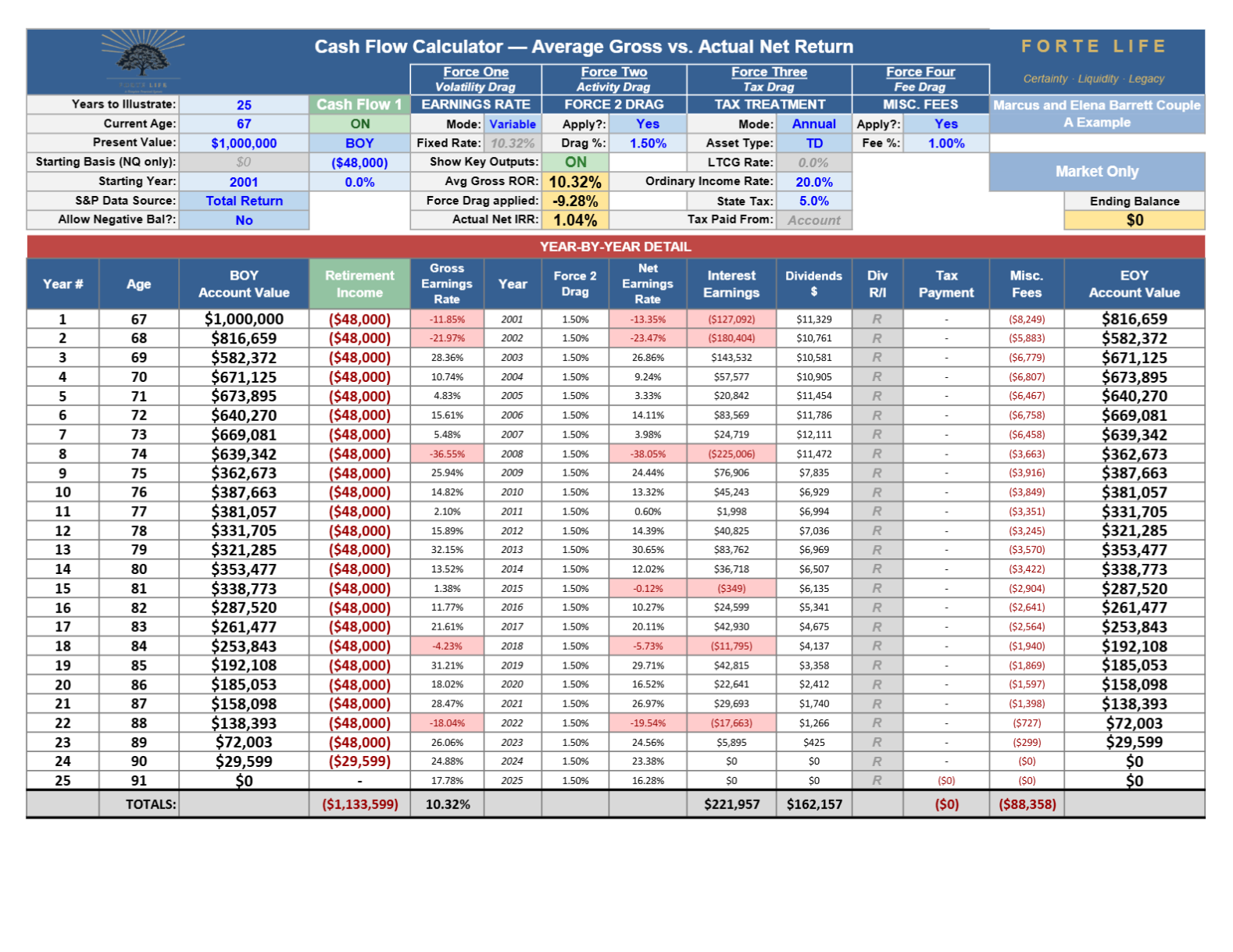
Same market. The index earned 10.32%. The saver kept a healthy fraction of it. The retiree, drawing income through the very same years, kept 1.04% and then ran out. Nothing was mismanaged. They drew a reasonable income from a reasonable balance in a good market — and the order those returns arrived in emptied the account while they still needed it. That is sequence-of-returns risk, and it is the whole reason the descent is a different climb.
"But You Picked a Bad Example"
It is the natural objection, and it deserves a real answer rather than a reassurance. So here is the answer: we ran every example.
The last century offers seventy-six rolling twenty-five-year retirements — every start-year from 1926 through 2001. Run that same household through all seventy-six, nothing chosen and nothing skipped, and the picture does not soften. In seven of the seventy-six, the market-only plan ran its income dry while the household was still alive — roughly one retirement in eleven, with no way to know in advance which one you'll be handed. Not a curated six. The full record.
This is where most people's instinct goes to prediction — so is the market about to be bad? — and that is the wrong instinct, because no one can answer it. You cannot know whether the rough years land at the start of your retirement or the end. What you can do is stop needing to know.
Think of it as the choice of a vehicle for a long trip. If raw speed were the only thing that mattered, you would cross the country on a racing motorcycle — nothing is faster on an open, dry road. But no one actually does, because the trip is not a sprint. It runs through weather you cannot time, it has to carry the people you love, and above all it has to arrive. So people take the car — a little slower at the top end, and in exchange a windshield, seatbelts, a roof, and room for the family, built to finish the journey in whatever weather turns out to be waiting.
A market-only retirement is the motorcycle. On the clear, dry stretches it is quicker, and it will sometimes finish richer. But that measures top speed on a good road, when the thing that decides a retirement is whether you arrive — through weather no forecast can time, with an income that never stops and something left for the people in the car with you.
The point of a plan is not to predict the weather. It is to install the pieces that shrink the range of what can happen to you and raise the odds of arriving — whatever actually comes.
The car does not predict the storm. It makes the trip survivable in all of them.
The Other Half of the Problem: the Tax Machine
Sequence risk is the danger every retiree has at least heard named. There is a second one almost none have, and it costs real money: the tax code, which was a quiet background expense while you were working, becomes an active machine the day you start drawing income.
The deepest piece of it is a bet most savers never knew they placed. Every 401(k) and IRA rests on one unstated promise: defer the tax now, and pay it later at a lower rate. That is not a fact — it is a wager on a future tax rate you do not set and cannot control. And the honest reading of the ground beneath it is not comforting: the federal debt has roughly doubled in a decade, the interest on it now exceeds the entire defense budget, and today's top tax rate sits near the lowest it has been in a century — 37% against the 70%, 91%, even 94% of decades past. Betting a lifetime of savings on rates staying this low, or falling further, is a wager against the more probable direction. Again — the move is not to predict the rate. It is to stop being all-in on the one bucket whose future rate you can't control, and to hold money across all three: tax-deferred, taxable, and tax-free.
On top of that bet run the machine's gears — the way ordinary income can drag your Social Security into taxation, the Medicare surcharges that jump the instant your income crosses a line, the required withdrawals that force money out whether you need it or not, and the fact that assets sold to you as "tax-free," like municipal bonds, still count against every one of those triggers. It is the subject the full whitepaper works out in dollars. What matters here is that the descent has two forces working against a market-only plan at once — the order of returns, and the tax machine — and the tools that answer them are the same two pieces.
The First Tool: a Paycheck the Market Can't Touch
The first move is not to find a better-behaved market. It is to take the part of your income that simply must arrive — the floor you cannot do without — and remove it from the market's reach entirely.
The instrument that does this is a guaranteed lifetime income annuity, and there is a plainer name for it, one most people already trust without a second thought: a pension. A traditional pension pays for life because it pools thousands of people together — some live long, some don't, and the average is knowable even though no single life is — and no one ever accused their pension of being a bad deal for "not getting it all back." A lifetime annuity is simply a pension you build for yourself, in an era when almost no employer still hands one down. It is why a properly structured contract can pay a rate for life that no self-funded account can safely match: it is the one structure that can promise a payment for exactly as long as you live and not one year less.
Switch it on for that same couple — the one whose $1,000,000 ran dry at ninety — and the identical million instead pays $48,000 every year for as long as either spouse lives, and leaves a legacy larger than they retired with. More income and more inheritance, from the same starting balance. And here is the part that matters for anyone reading this who is already at or near retirement: this piece needs no runway. You can put it in place the day you retire.
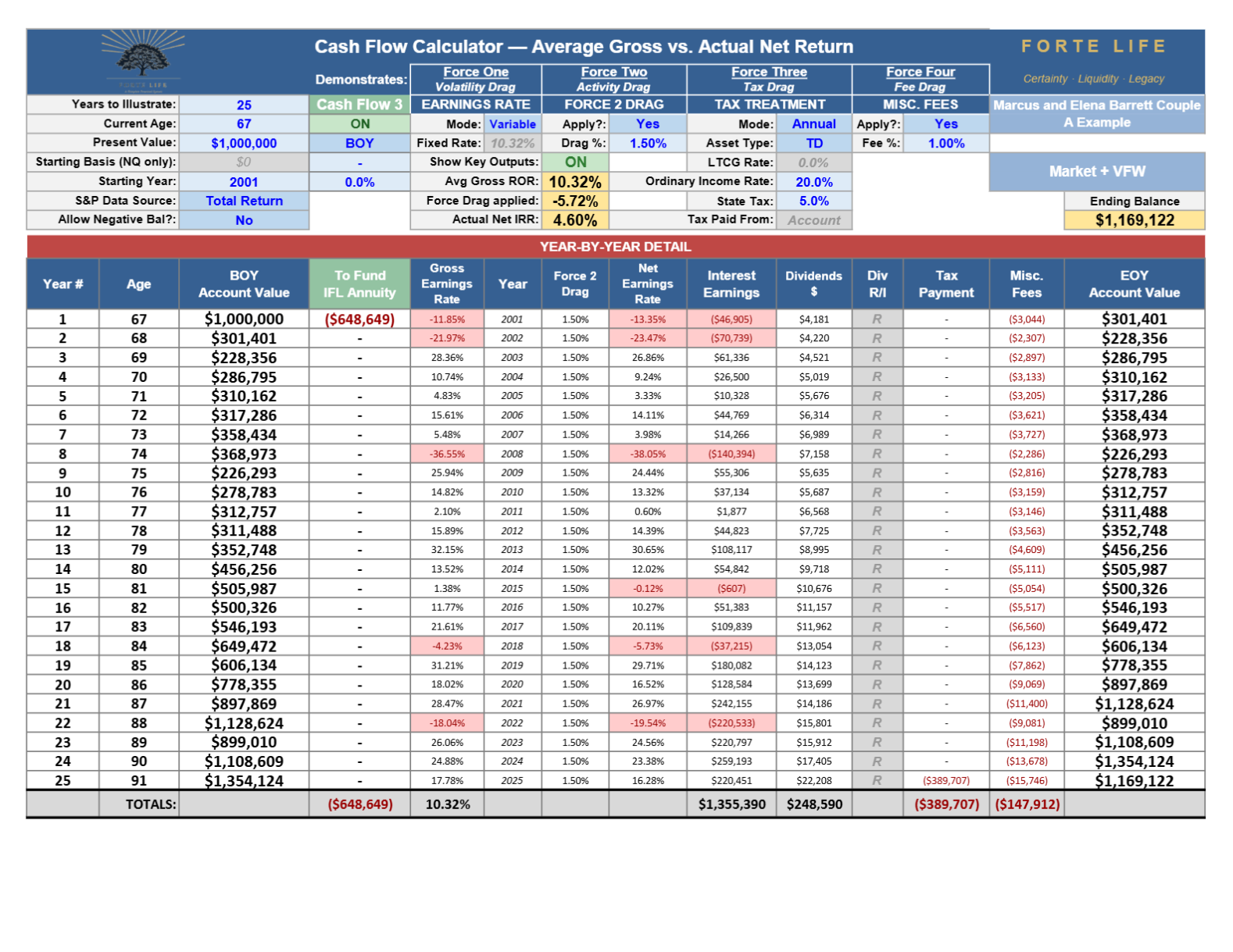
It is never too late for the floor.
The Second Tool: the Reservoir You Dig Before the Drought
The floor covers what you must have. Most retirements want more than the floor — travel, the grandchildren, the fullness of a life — and that extra income is where you still want the market's growth, and exactly what sequence risk attacks. The second tool is built for that dollar.
A reservoir is dug in the wet years.
That is not a detail of how reservoirs work; it is the whole of how they work — you store water while it is plentiful precisely so there is something to draw when it is scarce, and the one thing you cannot do is dig the reservoir after the drought has arrived. The Volatility Buffer obeys the same law. It is a non-correlated reserve — the cash value of a properly structured whole life policy, the instrument the companion Coordinated Dollar analysis takes apart in full — and its job is simple: in the year after a market loss, you draw your discretionary income from the reservoir instead of the portfolio, and you leave your shares alone to recover on their full balance. That is the 24.7% problem defused — not by predicting the down year, which can't be done, but by having somewhere else to draw from once it has happened.
Because it must be built, it carries the one caveat the floor does not: it takes some years of funding to fill. But less than people fear — roughly five to six years, not a decade — and the runway does not even have to fall before you retire, only before the reservoir is first needed. Tested across all seventy-six windows of the last century, this single rule — don't sell into the recovery — improved the market money's outcome in every one of them. Not most. Every one. Because leaving your shares alone to recover is not a bet that sometimes pays; it is an edge that compounds in every history the market has ever produced.
What It Looks Like in One Family
Meet Marcus and Elena, both sixty-seven, just retired. Their life costs $144,000 a year — $108,000 for the necessities, and $36,000 for the things that make retirement worth reaching. Against that they hold $50,000 of Social Security and a $10,000 pension, so their own savings have to produce the rest.
Hold one fact still, because the whole story turns on it: both roads save the exact same money. Ten years earlier, at fifty-seven, the Barretts had $645,000 saved and were already putting away $44,000 a year, with a $12,000 employer match. On the conventional road, all of it goes to the 401(k), which grows to $2,000,000 by sixty-seven — and then they draw their income from it and spend the next quarter-century watching a falling account fund a rising share of their spending, exactly as Section after section of the record warns. On the coordinated road, the same $44,000 is simply pointed differently — some to the 401(k), some to a properly structured policy — and at retirement they build the two tools. A slice of the balance becomes the Firewall, a lifetime annuity that, with their Social Security and pension, covers the entire $108,000 floor by contract, with zero market exposure. Only the $36,000 of discretionary income is drawn from the market — and it is drawn with the Buffer, which stepped in five times across the 2001–2025 window, each year after a loss, leaving the sleeve to recover untouched.
The coordinated household's market sleeve ends the window at $1,595,451 — plus a lifetime income that cannot be outlived and a death benefit for the children, neither of which is in that number. They gave up nothing in lifestyle to get there. The only thing that changed was where the same dollars were pointed, and whether the plan was built for the descent or merely extended into it.
The Two Fears, Answered at Once
Underneath all of the arithmetic sit the two fears every retiree carries, whether or not they ever say them aloud. One is that you live longer than the money lasts — that the account that looked like plenty at sixty-seven becomes a number you watch fall. The other is that you go too soon — before the years you were counting on — and leave the people you love with less than you meant to.
Almost every financial product asks you to insure against one of these by betting against the other. Buy the lifetime income and you've bet on living long; die early and you got little for it. Buy the death benefit and you've bet on going early; live long and it did nothing for the years you actually spent. The coordinated plan is built to refuse that choice. The lifetime income and the death benefit are not two competing bets — they are two halves of a single hedge on the one thing you cannot know, which is how long you will live. Live long, and the income you cannot outlive is the answer. Go early, and the death benefit lands at its highest value. The household stops having to wager on its own timing at all. That is the deepest thing a coordinated plan does, and it is not a rate of return — it is the removal of the one risk no rate could ever have covered.
What This Means for You
Strip out the arithmetic and here is what remains.
You spent your working life learning to climb, and you climbed well — that is why you have something to spend. But the tools that got you up the mountain are not the tools that get you down it safely, and no one is going to hand you the descent kit automatically. A market-only plan is not wrong because the market is bad; the market is a genuine and necessary engine, and every coordinated plan keeps a sleeve of it. It is incomplete because it asks the market to do the one job the market was never built for — to guarantee a paycheck, in an order no one can choose.
I am not going to tell you what to do about that in an article, because your numbers are not the numbers on these pages. What I will tell you is that the difference between a retirement exposed to the order of returns and one built to withstand it is not made up on rate. It is made up on structure — and structure is the thing you can still change, whether you are ten years from the summit or standing on it right now.
If you want to see how the descent looks on your own numbers, that is a Retirement Income Diagnostic: a focused look at how your plan is actually arranged — your income, your exposure to sequence and taxes, and your legacy — and whether they work as one system or simply sit side by side. You leave knowing where your seams are, whether or not you ever do anything about them. What it produces is a coordinated Retirement Income Plan — principles first, then strategy, then whatever instruments the plan actually calls for, with one person designing for the whole.
The summit was the easy half. The descent is the one worth planning for.