One Dollar, Two Jobs
The safe money you keep ready earns almost nothing while it waits — and stops earning the moment you use it. Here is the money that does neither.
Living Asset Strategy series · The Coordinated Dollar · the Highlights — about an 8-minute read, one of four layers.
Built from “The Coordinated Dollar,” the full analysis. Every figure below traces to a real carrier illustration or a real property model.
The Money That Has to Sit Still
Somewhere on your balance sheet is a pool of money whose only job is to be ready. Call it your Opportunity Fund. It is what lets you move on a Tuesday — take the building, cover the shortfall, buy the partner out. You do not keep it small, because the entire point of it is to be there when something good shows up. So you carry it. For years. Sometimes decades.
And here is the strangest trade in personal finance, one almost nobody says out loud: to be ready, your money has to sit still. The reserve that lets you act fast is the reserve that earns the least while it waits.
It is the same trade underneath everything you own. Money that grows is not safe. Money that is safe and reachable earns almost nothing. Money that is safe and earning something is locked up for a term.
Growth. Safety. Access. Pick two, give up the third.
You will never get a statement showing what that idle money failed to earn — which is exactly why it has never been fixed.
The Moment the Compounding Stops
Now picture the deal you actually wanted. You write the check — cash, no debt, no lender. It should feel good, and it should: paying cash is not a mistake.
But watch the money the instant the check clears.
It stops.
Whatever that capital had been doing — earning, compounding, growing — it is now a building. The compounding didn't slow; it ended. Nothing bad happens, which is why no one catches it: the loss is an absence, the growth that dollar would have kept producing had it never had to leave. Over one deal, a rounding error. Over thirty years of someone who does deals, one of the largest numbers on the balance sheet.
So the question is simple: what if the dollar never had to leave?
One Dollar, Two Jobs
Here is where the same dollar does two things at once. One building, three ways to buy it — same property, same price, same rent, same fifteen years. The only thing that changes is where the money comes from.
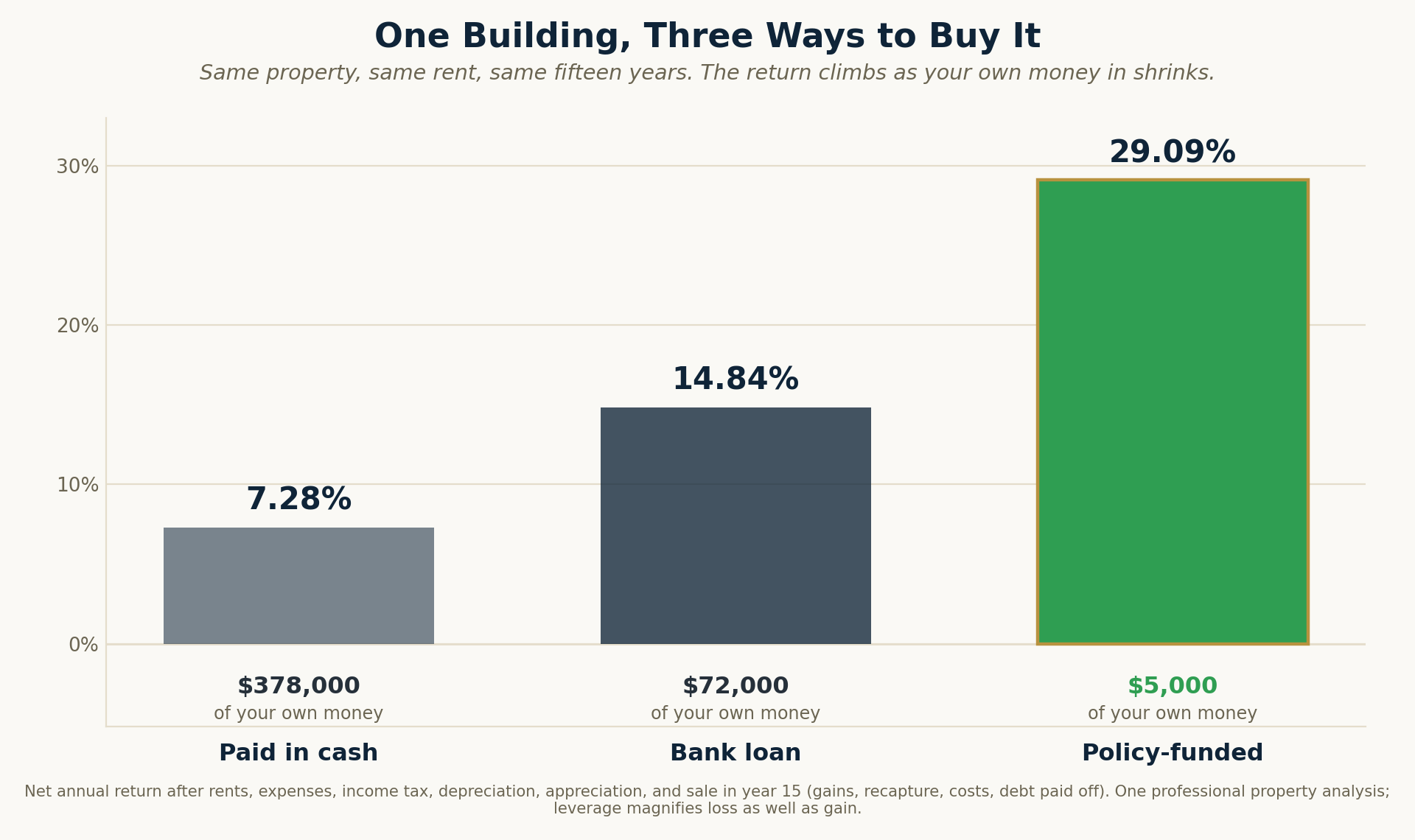
| Paid in cash | Bank loan | Policy-funded | |
|---|---|---|---|
| Your own money in | $378,000 | $72,000 | $5,000 |
| Net annual ROR on it | 7.28% | 14.84% | 29.09% |
A $360,000 rental. $3,300 a month in rent. Three percent appreciation. Nothing exotic. Net annual ROR — after rents and expenses, after income tax and depreciation, after appreciation, and after selling in year fifteen with capital gains, recapture, selling costs, and all remaining debt paid off. This is leverage on a good property, done deliberately — it multiplies a loss in exactly the same proportion, and these are the figures for a sound rental under stated assumptions, not a promise.
The building never changed. The funding did. The return climbs because the amount of the buyer's own money shrinks — from $378,000 to $5,000 — while borrowed money, each layer costing less than the property earns, does the rest. That is the entire mechanism. There is no third thing happening.
Now the part that matters more than the number. The $67,000 that funded that down payment was borrowed against the policy's cash value — not withdrawn from it. The money never left. So the entire time it was working as a down payment on that property, it was simultaneously still inside the policy — compounding, and carrying its death benefit.
One dollar. Two jobs. At the same time.
And the building repays the loan. The rent does it — not you. Marcus paid his $12,000 a year, exactly as he would have anyway; the tenant retired the $67,000 loan — $94,354 with interest — and he never wrote a repayment check.
Not free, and worth saying so: the loan came from the insurer against his cash value as collateral, and the interest went to the insurer. At sixty-seven the contract holds $581,400 where it would have held $593,235 had he never borrowed — about $11,835 less. That $11,835 bought a building funded almost entirely by borrowed money, and a loan someone else paid off — while the capital behind it never stopped compounding. Capital that is never interrupted.
The Question That Replaces "What's My Rate?"
Once a dollar can be in two places at once, the small question — what's the cheapest way to borrow — stops being the point. The real one is what is the highest use of this dollar. The instrument stops being a financing trick and becomes a warehouse for capital awaiting deployment: money that earns while it waits, stays reachable on demand, and does not stop working the moment it goes to work somewhere else. Which is the answer to the trade you never agreed to — Growth, Safety, and Access, held by the same dollar. Not two of three.
What This Actually Is
By now you may be wondering what "the policy" even is. Let me name it plainly.
It is a properly structured whole life policy, held with a participating mutual insurer.
The two words that carry the weight are properly structured — because most whole life is not built this way, and that difference is the entire reason the numbers above are possible. If you've ever heard whole life criticized, the criticism was aimed at the ordinary design: a policy built to maximize commission and death benefit, sold to someone who was never shown the arithmetic. This is the opposite of that:
By "properly structured" I mean a specific design — a minimized base policy with a maximized paid-up-additions rider, funded right up to but under the tax line. That is not how most whole life is built, and not something to assume your current agent will get right without asking.
There's a reason the right design is rare, and it doesn't flatter my own profession: the design that serves the client best pays the advisor least. In a recent case, the properly structured version paid the agent about 18.8% of what a conventionally built policy would have paid on identical premium — roughly eighty percent less. That's precisely why badly built policies exist — and why asking how a policy is designed, before anything else, is the rational move.
And the Safe Money, Too
Everything so far is what the dollar does while it is working. Holding safe money is the quiet job it does the rest of the time — and it is the reserve this whole piece began with. That idle safe sleeve — the bonds and cash every plan already carries and expects modest returns from — has the same better home:
| $100,000 safe sleeve · 25 years | Net rate | After 25 years |
|---|---|---|
| Bonds + cash, as typically held | 3.40% | $230,879 |
| Policy cash value | 5.00%, Tax-Free | $338,635 |
Same safety. Same access. $107,756 more.
Read it net to net, the only fair kind: the bond's 5.4% is a headline rate — before its fund fee and the income tax it owes every year it keeps just 3.78%, and the cash keeps 2.25%; blended, the ordinary sleeve grows to $230,879. The policy's 5.00% is already net, and Tax-Free. Even with the entire sleeve in bonds and no idle cash at all, the most the safe money keeps is $252,838 — still short of the policy's $338,635, because the bond is charged a fee and taxed every year it works and the cash value is not.
One detail makes it click: the dividend funding that cash value is itself produced largely by high-grade bonds inside the insurer's own account — the same kind of asset, in a place that doesn't tax it every year and doesn't lock it for a term. (The full breakdown — the bonds and the cash spelled out to the dollar — is the Accumulation series' subject; here it's enough to know the reserve has the same better home.)
The Part That Costs You
For roughly the first five years, cash value trails the money paid in. Year one: $12,000 paid, $9,714 of cash value. That gap is real and no framing removes it.
By year five it crosses over — $60,021 against $60,000 — and never trails again. By year twenty-five, on $300,000 of premium, the contract holds $593,235, and out-of-pocket funding stops entirely.
Five lean years to build a position that then does several jobs at once for the next forty. If you think in decades, that's not a cost. It's a capitalization period. But you should walk in knowing it's there.
It Pays at Both Ends
This isn't only for the building years.
At sixty-seven, the same contract converts to income at a 6.41% payout — $38,000 a year, Tax-Free, for twenty-five years. It doesn't deplete. And at ninety-two, after paying out a cumulative $950,000 of income on a contract funded with $300,000, it still leaves $165,676 behind.
The 29.09% in deployment, the 6.41% at income, and the safe-money advantage all come from the same thing: capital that was never interrupted.
Which is why judging this by its accumulation rate misses nearly all of it. What a dollar is worth isn't the rate it posts in the middle of its life. It's what it can do across the whole of it — sitting safely, deployed, borrowed against, converted to income, and passed on. Most assets do one of those. This one does all of them, and never has to stop doing one to start the next.
Traced, Not Argued
None of the above is a sales argument. The property figures come from one professional analysis carrying real amortization, depreciation, taxes, and selling costs. The policy figures come from one real carrier illustration for one real design, reproduced without adjustment.
One honest note that runs against the case, stated anyway: the policy's illustrated 5.00% Actual Net Return assumes the carrier's current dividend scale of 6.00% — a scale sitting below 74% of its own thirty-eight-year history, which the illustration is required to hold flat for life. It is quoted near its floor, and the conclusions hold regardless.
Where to Begin
Read the full analysis → The Coordinated Dollar — the complete Living Asset Strategy, with every ledger, every scenario, and every critique answered in full.
Or start with your own numbers → book a Capital Coordination Session. A focused look at how your capital is actually arranged — your reserve, your deployments, your tax exposure, your legacy — and whether they work as one system or simply sit side by side. You leave knowing where your seams are, whether or not you do anything about them. What it produces is a coordinated Retirement Income Plan — principles first, then strategy, then whatever instruments the plan actually calls for, with one person designing for the total.