The Dollar That Was Doing Nothing
Why the money you keep ready is the most expensive money you own — and what changes when the same dollar stops having to choose.
Living Asset Strategy series · The Coordinated Dollar · Article — about an 11-minute read, one of four.
There is a particular frustration that only shows up once you have built something. It arrives the day a deal you actually want comes across your desk — a building at the right price, a partner buying out, a piece of equipment that would double a line's output — and someone asks how fast you can move. You already know the answer, because you have run the arithmetic in your head for years.
You have the money. That is not the problem. The problem is where it is.
Some of it is in the market, and taking it out means selling something — possibly at a bad moment, certainly with a tax bill attached. Some is in a bank account, which is exactly why you can move fast, and exactly why it has earned almost nothing for four years. Some is in a bond or CD ladder that will not mature for another eighteen months. And some, if you are honest, is money you have deliberately kept doing nothing at all, because you wanted to be ready. Call that last pool your Opportunity Fund — the capital you hold on purpose for the deal, the shortfall, the moment worth moving on.
That Opportunity Fund holds the strangest trade in personal finance, and almost nobody names it out loud:
To be ready, your money has to be unproductive.
Not somewhat less productive. Unproductive. The reserve that lets you act on a Tuesday is the reserve that earns four-tenths of a percent while it waits. And you do not keep it small, because the whole point of it is to be there when something good shows up. So you carry it. For years. Sometimes decades.
It is the same trade that sits underneath everything else on the balance sheet. Money that grows is not safe. Money that is safe and reachable earns almost nothing. Money that is safe and earning something is locked up for a term.
Growth. Safety. Access. Pick two, give up the third.
The companion Accumulation analysis takes that trade apart on the market side — what a growth dollar actually keeps after volatility, fees, and taxes have each taken a turn. This article is about the other dollar: the safe money kept ready, and the one property of it that changes everything. You will never receive a statement showing what that idle money failed to earn — which is precisely why the cost has never been fixed.
The Moment the Compounding Stops
Go back to the deal, and say you do it the way most disciplined people do. You write the check. Cash, or close to it. No debt, no lender, no covenants. It should feel good — and I want to be careful here, because it should. Paying cash is not a mistake, and I am not about to tell you debt is clever.
But watch the money at the instant the check clears.
It stops.
Whatever that capital had been doing — earning, compounding, growing — it is now doing exactly one thing. It is a building. The compounding did not slow down; it ended. That dollar left one job to take another, and there was never a moment when it held both.
Nothing bad happens, which is why no one catches it. The deal is fine. The building performs. There is no loss to point at, because the loss is an absence — the growth that dollar would have kept producing had it never had to leave. Over one deal, a rounding error. Over thirty years of a person who does deals — buys the building, funds the expansion, replaces the equipment, seizes the thing that comes along — that absence becomes one of the largest numbers on the balance sheet. And nobody calculates it, because no one sends a statement for a job your money did not get to keep.
So here is the question this whole article exists to ask:
What if the dollar never had to leave?
One Dollar, Two Jobs
I want to show you what that looks like with a real property and real figures, because the idea sounds like a trick until you see the arithmetic — and then it stops sounding like one.
Take a rental: $360,000 purchase price, about $378,000 all-in once costs are counted, $3,300 a month in rent, held fifteen years, appreciating at a modest three percent a year. One building. Nothing exotic. There are three ways to buy it, and every input is identical across all three — same property, same price, same rents, same expenses, same appreciation, same fifteen years. The only thing that changes is where the money comes from.
Every number below is a net annual rate of return on the money actually invested: rents in, operating expenses and income tax out, depreciation counted, three percent appreciation, and the building sold in year fifteen with capital gains, depreciation recapture, selling costs, and any remaining loan paid off before the return is figured. It is what the investor keeps, annualized.
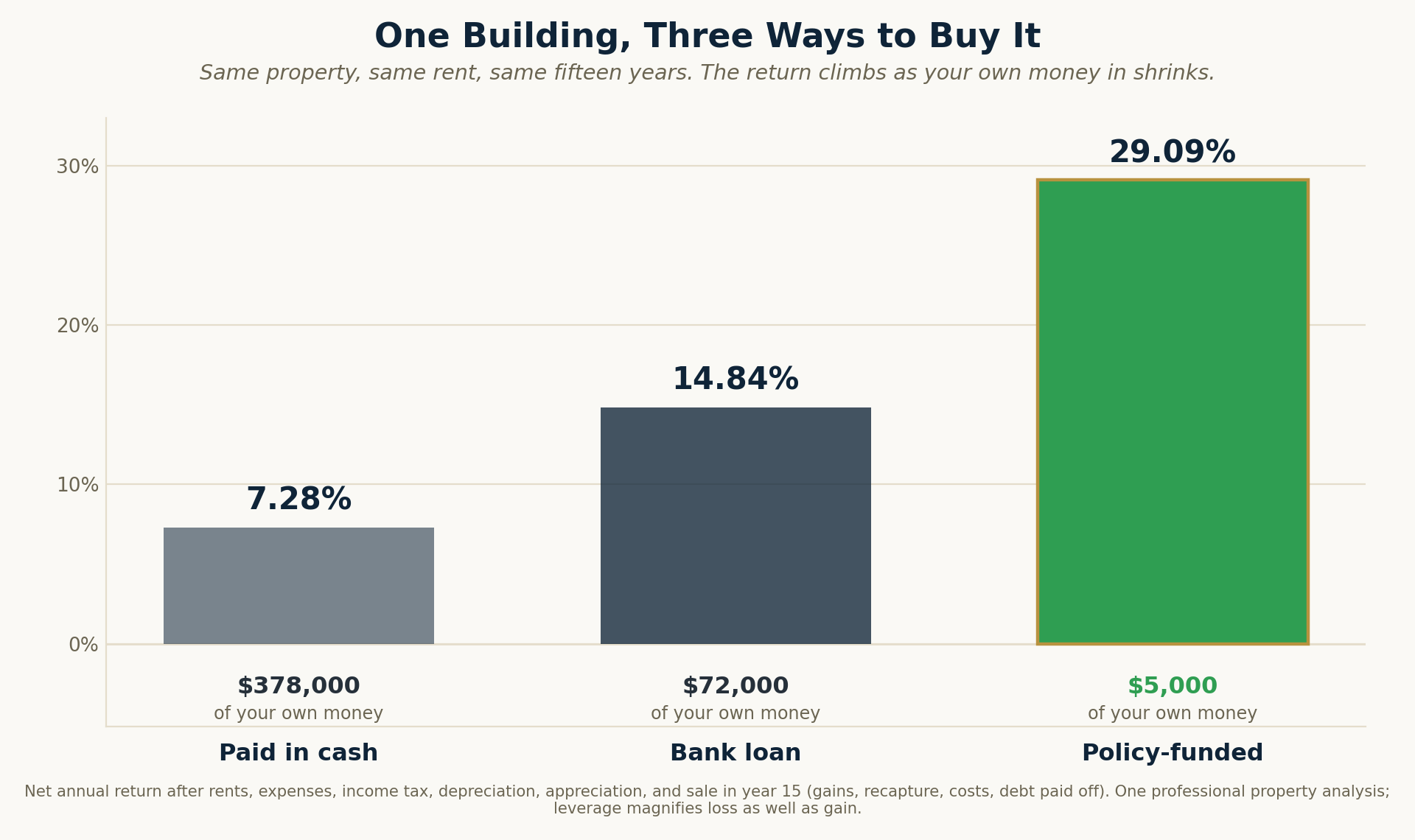
Buy it with cash. You put in $378,000 of your own. Over fifteen years the property returns 7.28% net, annualized — not 7.28% total, but 7.28% a year, after everything. That is the building's honest, unlevered performance, and it is a perfectly respectable number.
Buy it with a bank loan. You put in $72,000 and borrow $306,000. Because the bank's money costs less than the 7.28% the building produces, every borrowed dollar earns more than it costs, and the surplus flows to the money that is actually yours. The same building now returns 14.84% a year, net. Same property, same rent, different structure.
Now buy it a third way. You put in $5,000 of your own cash. You borrow $306,000 from the bank as before — and you fund the down payment with a $67,000 loan taken against a properly structured whole life policy, at 5.30%, comfortably below what the leveraged position is now producing. A second layer of positive spread stacks onto the first, and the same building returns 29.09% a year, net.
The building never changed. The funding did. The return climbs because the amount of the buyer's own money shrinks — from $378,000 to $5,000 — while borrowed money, each layer costing less than the property earns, does the rest. There is no third thing happening.
Now the part that matters more than the number. That $67,000 was borrowed against the policy's cash value — not withdrawn from it. The money never left. So for the entire time it was working as a down payment on a property returning 29.09%, it was simultaneously still inside the policy — compounding, and carrying its death benefit.
One dollar. Two jobs. At the same time.
And the building repays the loan. The rent does it — not you. Marcus paid his $12,000 a year, exactly as he would have anyway; the tenant retired the $67,000 loan — $94,354 all in with interest — and Marcus never wrote a repayment check.
That is not free, and I am not going to call it free. The loan came from the insurer's own account against his cash value as collateral, and the interest went to the insurer, so carrying it costs the policy something. At sixty-seven the contract holds $581,400 where it would have held $593,235 had he never borrowed — about $11,835 less. That is the whole price. What it bought was a building that turned $5,000 of his own money into a 29.09% net annual return, and a loan somebody else paid off — while the capital behind it never stopped compounding.
The Question That Replaces "What's My Rate?"
Once a dollar can be in two places at once, the question you have been asking your whole financial life turns out to be the wrong one.
The usual version of this conversation is small. Someone shows you that a 5.30% policy loan beats a 6% car loan and invites you to feel clever about saving seven-tenths of a point. That optimizes a rounding error — and honestly, it is why the way this concept is usually marketed has a reputation for being unserious.
The real question is not what is the cheapest way to borrow. It is what is the highest use of this dollar — and once that becomes the governing question, the answer sometimes inverts everything the usual pitch tells you. If the policy dollar could be deployed into something producing a genuine double-digit return, then the correct move is to take the more expensive bank loan for the car and preserve the policy capital for the higher use.
The instrument stops being a financing trick. It becomes a warehouse for capital awaiting deployment — money that earns while it waits, stays reachable on demand, and does not stop working the moment it goes to work somewhere else. Which is the answer to the trade you never agreed to: Growth, Safety, and Access, held by the same dollar. Not two of three.
What Kind of Asset Does This
At this point the name matters, and I would rather say it plainly than dance around it.
It is a properly structured whole life policy, held with a participating mutual insurer.
I know what that name carries. Most of the baggage is earned — earned by policies designed the wrong way and sold to people who were never shown the arithmetic. So the phrase properly structured is not decoration. It is the entire difference between an instrument that does what I just described and one that does not.
By properly structured I mean a specific design: a minimized base policy with a maximized paid-up additions rider — an add-on that pushes as much of your premium as the tax code permits into cash value rather than into death benefit — funded right up to but under the line the IRS draws. That is not how most whole life is built, and not something to assume your current insurance agent will get right without being asked directly.
There is a reason it is rare, and it does not flatter my own profession: the design that serves the client best pays the advisor least. Agent compensation is driven almost entirely by base premium, and this design pushes most of the premium into the rider instead. In a recent case, the properly structured version paid the agent about 18.8% of what a conventionally built policy would have paid on identical premium — roughly eighty percent less. That misalignment is exactly why badly structured policies exist, and why a buyer who asks about structure before anything else is behaving rationally.
And the Safe Money, Too
The dual-use dollar is the headline. But the same contract quietly does one more thing, and because the companion Accumulation analysis proves it in full, a paragraph is enough here.
The idle reserve this article opened with — the bonds and cash every serious balance sheet already carries and expects modest returns from — has the same better home. Held the ordinary way, a $100,000 safe sleeve keeps about $230,879 over twenty-five years, net of its fund fee and the income tax it owes every year. The same $100,000 in the policy's cash value keeps $338,635 — $107,756 more — at an illustrated 5.00% that is already net and tax-free, set against a bond whose 5.4% headline keeps only 3.78% after fee and tax. Same safety, same access, more kept. And the detail that makes it click: the dividend funding that cash value is itself produced largely by high-grade bonds inside the insurer's own account — the same asset class, in a place that isn't taxed every year and isn't locked for a term.
The full derivation — the bonds and the cash spelled out to the dollar, and why even an all-bond sleeve with no idle cash still finishes short — is the Accumulation series' whole subject, and I won't repeat it here. What matters for this article is the part Accumulation doesn't cover: the reserve isn't just held in a better place. It is a dollar you can use — deploy it, borrow against it — without ever emptying it. That is the difference between a better parking spot and a second job.
The Part That Costs You
I would not trust this article if it did not tell you the hard part, so here it is.
The policy in these figures belongs to a man I will call Marcus — forty-two, healthy, funding $12,000 a year. From the first day he has $251,264 of death benefit a savings account would never have given him. But for roughly the first five years, his cash value trails the money he put in. Year one he has paid $12,000 and the cash value shows $9,714. That gap is real, it is the honest cost of the structure, and no framing makes it disappear.
By year five it crosses over — $60,021 of cash value against $60,000 paid — and it never trails again. By year twenty-five, on $300,000 of premium, the contract holds $593,235, and his out-of-pocket funding stops entirely, carried from there by the policy itself. Five lean years to build a position that then does several jobs at once for the following forty. If you think in decades, that is not a cost — it is a capitalization period. But you should walk in knowing it is there.
It Pays at Both Ends
There is a tendency to file this under "strategies for the building years" — useful while you are doing deals, irrelevant afterward. That badly understates it, and for the most elegant reason in the whole approach: the same property of the contract that produced 29.09% in deployment is the property that governs what it does at the end.
At sixty-seven, Marcus's policy converts to income at a 6.41% payout on its cash value — $38,000 a year, Tax-Free, for twenty-five years. It does not deplete. And at ninety-two, after paying out a cumulative $950,000 of income on a contract he put $300,000 into, it still leaves $165,676 behind.
The 29.09% in deployment and the 6.41% at income come from the same thing:
capital that was never interrupted. Which is why measuring this instrument by its accumulation rate misses almost all of it. What a dollar is worth is not the rate it posts in the middle of its life. It is what it can do across the whole of it — sitting ready, deployed, borrowed against, converted to income, and passed on. Most assets do one of those. This one does all of them, and it never has to stop doing one to start the next.
What This Means for You
Strip out the arithmetic and here is what is left.
Somewhere on your balance sheet is a pool of money whose only job is to be ready. You have accepted that its readiness is paid for with its productivity, because every structure you have ever been offered required that trade. It does not actually require it. And every time you have written a check for something worth buying — and you were right to buy it — the money that funded it stopped working the moment it left. That was never necessary either. It was simply the only option the structure you had made available.
I am not going to tell you what to do about that in an article, because your numbers are not the numbers on these pages. What I will tell you is that the difference between a balance sheet where every dollar does one job and a balance sheet where the right dollars do two is not small, and it is not made up on rate. It is made up on structure — and structure is the one thing you can still change.
If you want to see how it works on your own capital, that is a Capital Coordination Session: a focused look at how your money is actually arranged — your reserve, your deployments, your tax exposure, and your legacy — and whether they work as one system or simply sit side by side. You leave knowing where your seams are, whether or not you ever do anything about them. What it produces is a coordinated Retirement Income Plan — principles first, then strategy, then whatever instruments the plan actually calls for, with one person designing for the total.
Every figure in this article belongs to someone else's illustration. The ones that matter belong to you.